QUESTION IMAGE
Question
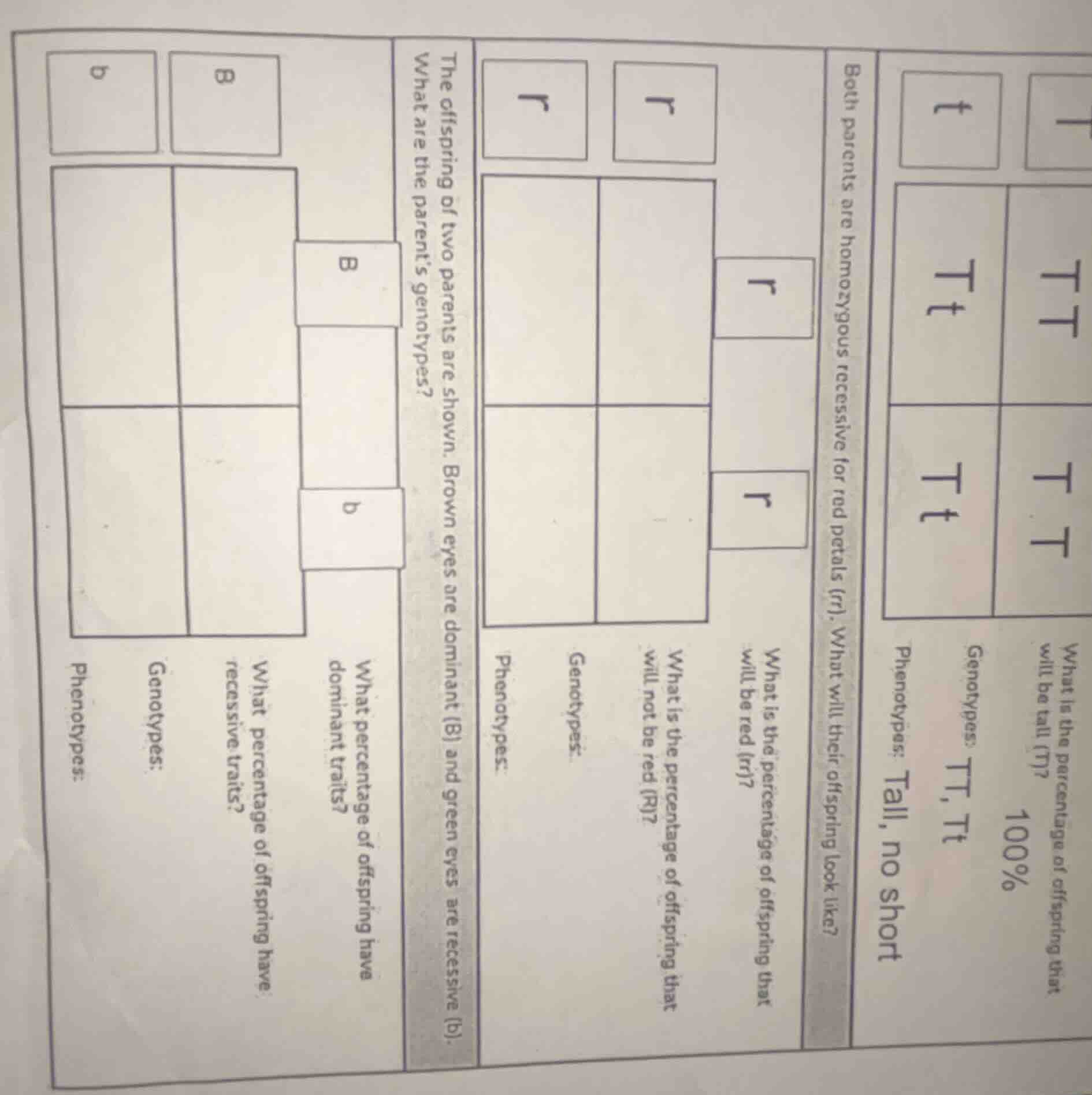
what is the percentage of offspring that will be tall (t)?
genotypes: tt, tt
phenotypes: tall, no short
both parents are homozygous recessive for red petals (rr). what will their offspring look like?
what is the percentage of offspring that will be red (rr)?
what is the percentage of offspring that will not be red (r)?
genotypes:
phenotypes:
the offspring of two parents are shown. brown eyes are dominant (b) and green eyes are recessive (b). what are the parent’s genotypes?
what percentage of offspring have dominant traits?
what percentage of offspring have recessive traits?
genotypes:
phenotypes:
First Sub - Question (Tall Trait)
Step1: Analyze Parent Genotypes
Looking at the Punnett square for the tall trait, one parent has genotype \( TT \) and the other has genotype \( Tt \)? Wait, no, looking at the first Punnett square (tall trait), the top row has \( T \) and \( t \), and the left column has \( T \) and \( T \)? Wait, the table shows for the tall trait: the Punnett square has cells with \( TT \), \( TT \), \( Tt \), \( Tt \). The parents' gametes: one parent is \( TT \) (since it contributes \( T \) only) and the other is \( Tt \) (contributes \( T \) and \( t \))? Wait, no, the question is "What is the percentage of offspring that will be tall (T)?". The genotypes of offspring are \( TT \), \( TT \), \( Tt \), \( Tt \). All these genotypes have at least one \( T \), and since tall is dominant (T), all offspring will be tall.
Step2: Calculate Percentage
There are 4 offspring in total. The number of tall offspring is 4. The percentage is calculated as \( \frac{4}{4}\times100\% = 100\% \).
Step1: Analyze Parent Genotypes
Both parents are homozygous recessive (\( rr \)). So each parent can only contribute \( r \) gametes.
Step2: Determine Offspring Genotypes
When we do the Punnett square, all offspring will have genotype \( rr \). Since red petals are associated with \( rr \) (recessive), all offspring will have red petals.
Step3: Calculate Percentage for Red (rr)
Number of offspring with \( rr \) is 4 (assuming 4 - cell Punnett square). Percentage is \( \frac{4}{4}\times100\%=100\% \). For non - red (R), since there are no \( R \) alleles, the percentage is \( 0\% \).
Step1: Determine Parent Genotypes
The offspring's Punnett square has one parent contributing \( B \) and \( b \) (wait, the Punnett square for eye color: the top row has \( B \) and \( b \), and the left column has \( B \) and \( b \)? Wait, the problem says "The offspring of two parents are shown. Brown eyes are dominant (B) and green eyes are recessive (b)". The Punnett square cells: let's assume the Punnett square has four cells. If we fill it, the parents' genotypes: since the gametes from one parent are \( B \) and \( b \), and from the other parent are \( B \) and \( b \)? Wait, no, the question "What are the parent's genotypes?" Looking at the Punnett square (eye color), the possible genotypes of offspring would be \( BB \), \( Bb \), \( Bb \), \( bb \) (if parents are \( Bb \) and \( Bb \)). But let's check the questions: "What percentage of offspring have dominant traits (brown eyes, B)?", "What percentage of offspring have recessive traits (green eyes, b)?", "Genotypes:", "Phenotypes:".
For dominant traits (brown eyes): Genotypes with \( B \) are \( BB \), \( Bb \), \( Bb \) (assuming Punnett square with parents \( Bb \) and \( Bb \)). So number of dominant - trait offspring: 3 out of 4. Percentage: \( \frac{3}{4}\times100\% = 75\% \).
For recessive traits (green eyes): Genotype \( bb \), 1 out of 4. Percentage: \( \frac{1}{4}\times100\%=25\% \).
Genotypes: \( BB \), \( Bb \), \( Bb \), \( bb \)
Phenotypes: Brown (for \( BB \), \( Bb \), \( Bb \)), Green (for \( bb \))

Snap & solve any problem in the app
Get step-by-step solutions on Sovi AI
Photo-based solutions with guided steps
Explore more problems and detailed explanations
100%